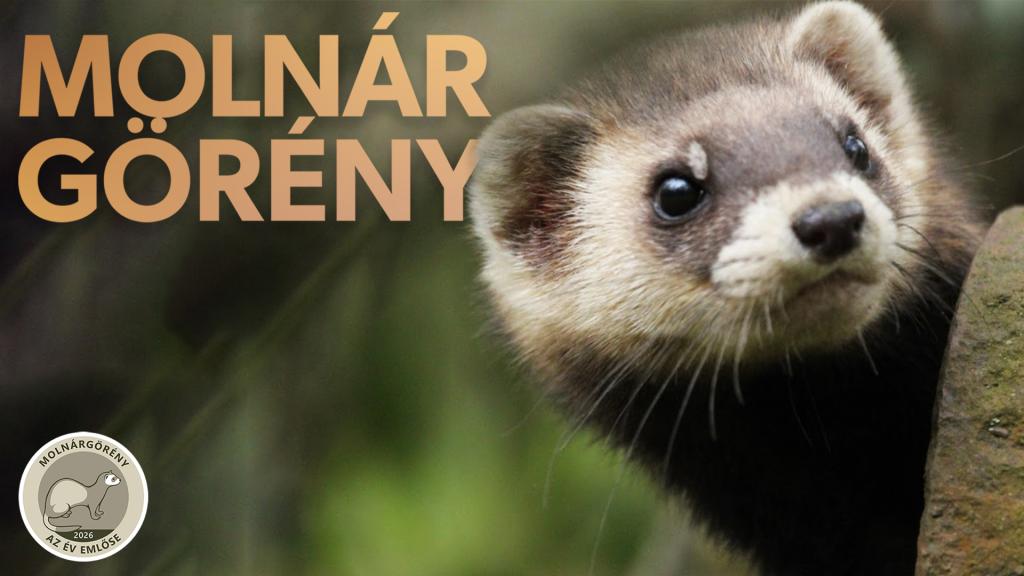
The professional community of the Vadonleső (Wilderness Watcher) Program has selected the Steppe polecat as the 2026 Mammal of the Year. This community data collection initiative is operated by the Ministry of Agriculture and the Herman Ottó Institute Nonprofit Ltd., with the cooperation of the Hungarian Natural History Museum and the Budapest Zoo.
The Steppe polecat (Mustela eversmanii) is a predator of open habitats, such as meadows and arable lands. In Hungary, significant populations are found in Győr-Moson-Sopron, Jász-Nagykun-Szolnok, Békés, Hajdú-Bihar, and Csongrád-Csanád counties. Due to its elusive lifestyle and low population density, this under-researched representative of the Hungarian mammalian fauna is rarely seen. It avoids forests and human settlements. Its underground shelter is often an abandoned hamster or ground-squirrel burrow, which the polecat widens to accommodate its larger body size. It periodically rotates between several dens and occasionally rests in haystacks. However, when raising offsprings, it remains loyal to a single shelter for weeks. During this period, the parents’ activity patterns change, as the young polecats venture out from the den to play almost exclusively during daylight hours.
A truly agile predator, it hunts primarily at night. Thanks to its elongated body and short legs, it preys on small ground-dwelling animals, mainly rodents—most frequently voles, hamsters, or ground squirrels. Its “masked bandit” appearance might be why folk tradition wrongly branded it a “henhouse raider,” but in reality, it is the hamsters, not the farmers, who have a legitimate reason to fear it. As a specialist predator, it can even catch its chosen prey within the hamster’s own burrow in so-called “hamster-rich areas.” Its Hungarian name, molnárgörény (“Miller polecat”), may stem from the fact that mills attracted many rodents, which in turn drew the voracious polecats. Other theories suggest its pale, “floury” fur coloration inspired the name.
In summer, its straw-yellow fur features blackish-brown guard hairs. The area around the eyes, the shoulders, the pelvis, the legs, and the tip of the tail are dark brown. Its winter coat is much denser, enriched with sand-coloured fur, with only the tips of the guard hairs appearing black. It closely resembles its relative, the European polecat (Mustela putorius), from which it is distinguished by its lighter shade. Genetic studies have shown that in areas where the two species coexist, there is a small probability of interbreeding. This can affect the genetic health and self-sustaining capacity of individual populations.
The species has been protected in Hungary since 1974. Since 2015, its distribution has been mapped nationwide through community data collection involving national park directorates and volunteers. Researchers use telemetry (attaching small GPS transmitters to individuals to track their movements remotely) to assess the Steppe polecat's home range. This averages 315 hectares for males and 220 hectares for females. Research also revealed that the size and spatial location of their territory vary by season: they move within smaller areas in winter than in spring. Their diet and lifestyle allow them to adapt through "prey-switching" if food sources change, such as during vole outbreaks when common voles become available in mass quantities.
Due to its dependence on open meadows, pastures and arable lands, its avoidance of humans, and its specific diet, the Steppe polecat has seen a significant decline in Europe. Roads also pose a threat, as they frequently fall victim to traffic. Additionally, non-selective rodent control methods in agricultural environments (poisoning, trapping), the thinning of prey populations, or the accumulation of various pesticides in their systems cause damage to polecat populations through indirect poisoning.
This year's Mammal of the Year also plays a significant role as a target species in the Grassland-HU LIFE Integrated Project. Project staff have laid the groundwork for a species conservation plan—to be completed as part of the project—through distribution and life-cycle studies. This plan summarizes vital information for conservation, from threat factors to protective measures. These measures are not only important for the Steppe polecat; nature-friendly management practices (e.g., fallowing, maintaining crop residues and field margins, placing out straw heaps, timing of mowing) also contribute to the development of eco-friendly arable ecosystems and the survival of healthy grassland communities. Other elements of the GRASSLAND-HU project—such as the network of model farms and the work of regional experts from the Grassland Conservation Management Advisory Service—aim to help farmers establish long-term sustainable management that ensures a stable way of making a living while preserving our natural heritage.
Tools for species conservation and awareness-raising also include international laws and conventions. The Steppe polecat is listed as a species of Community interest in Annexes II and IV of the EU Habitats Directive. Furthermore, the Bern Convention recognizes it as a strictly protected species.
In the “Mammal of the Year” initiative of the Vadonleső Program, experts are now putting the 13th species under the scope. On this occasion, a year-long program series draws attention to the importance and characteristics of the selected species and its environment. The event series offers entertaining and interesting activities throughout the year, including scientific and educational programs about the species and its habitat, as well as competitions for children and youth. In recent years, more than ten thousand entries—poem illustrations, posters, jewellery and coin designs, caricatures, comics, video clips, tales, and poems—have been submitted to the Vadonleső Program’s creative contests from various age groups. Nationally renowned artists, including writers, poets, musicians, and performers holding the title of “Ambassador of Nature Conservation,” have joined the program with their own works. Following their initiative, numerous poems, tales, and songs related to the Mammal of the Year have been published. Anyone interested can follow the latest events and programs on the Vadonleső and Herman Ottó Institute websites and social media platforms.
Source: Herman Ottó Institute Ltd.
Cover Picture: Created using a photograph by Nikolett Rózsa.