Natural and semi-natural habitat patches located within agricultural areas provide year-round refuge for wildlife. These areas fundamentally determine the habitat conditions of the rural landscape, which fluctuates according to the annual crop cycle. Between the harvesting of annual crops and the sowing of the next main crop, only field margins, shrub rows, and smaller natural habitat remnants offer cover for both birds and game.
It is a well-known fact that the extent of ecologically significant habitat patches in agricultural areas is declining. Recognizing this, the Common Agricultural Policy (CAP) Strategic Plan has announced a new funding opportunity for agricultural land users titled “Investments promoting the creation and maintenance of semi-natural and wetland habitats.” This grant supports the establishment and maintenance of grassy and shrubby strips on arable land, as well as the creation of wetlands on both arable and grassland areas.
The creation of grassy and shrubby strips results in the formation of permanent edge habitats at the margins of agricultural fields. These shrub rows break up the large-scale industrial farming structure, offer nesting sites for songbirds linked to the agricultural landscape, contribute to the survival of insect fauna, serve as excellent habitats for small game, and provide vital connectivity between distant habitat patches in otherwise bleak agricultural environments. Beyond their obvious nature conservation significance, they contribute to reducing soil erosion and improving microclimatic conditions.
The ongoing SakerRoads LIFE project of BirdLife Hungary (MME) focuses specifically on creating edge habitats along agricultural roads to ensure a food supply for birds of prey; you can read more about it [here].
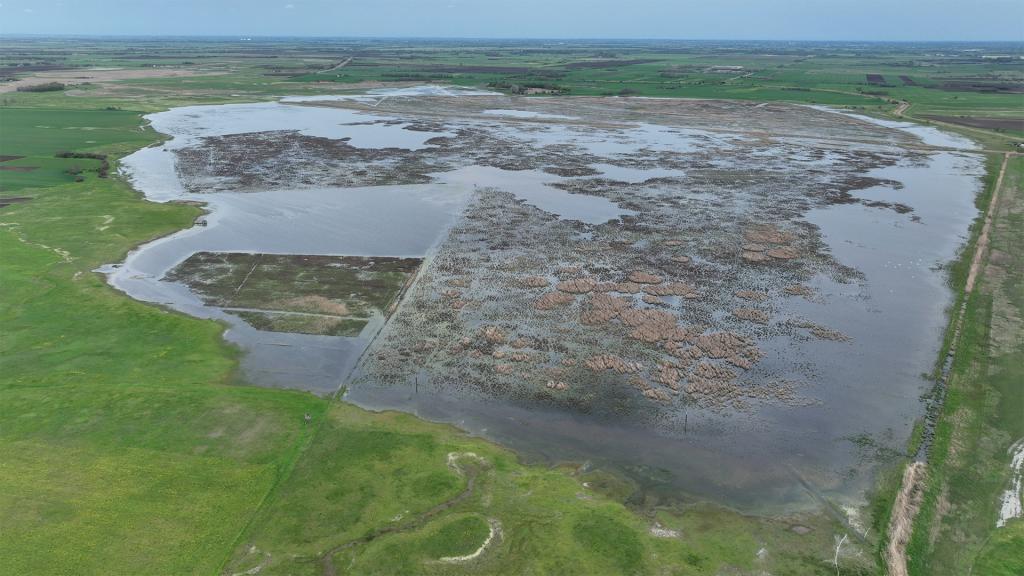
The depletion of wetlands is a regrettable consequence of climate change. Today, the majority of Hungary’s wetlands struggle with permanent water shortages, and in areas severely affected by climate change (such as the Homokhátság and Nyírség regions), many have dried up completely. Due to expected future climatic trends, the preservation of seasonal waters and ecological water replenishment in agricultural areas is significant not only for nature conservation. The preservation of surface and soil-stored water resources is expected to be one of the most serious environmental challenges for the agricultural sector. The water conservation objectives are supported by the specific target areas of the aforementioned call for proposals aimed at creating wetlands.
Wetlands are also of paramount importance for the conservation of our endangered bird species. Their protection is supported by MME’s Safehaven LIFE project, launched in 2025, which you can read more about [here].
The recently published call for proposals also represents a viable economic alternative for farmers. The funding amounts determined for the creation and maintenance of grassy-shrubby strips and wetlands fairly compensate farmers for their efforts and the loss of income resulting from taking land out of production. We encourage all stakeholders to consider using this support tool to take action for the development of agricultural habitats and the protection of our bird and small game species.
The application period opens on February 19, 2026. For further details and up-to-date information regarding the call, please monitor the kap.gov.hu website or contact the field officer network of the National Chamber of Agriculture (NAK).
Source: BirdLife Hungary (MME)
Photo: Gátér, water retention – Béla Tokody