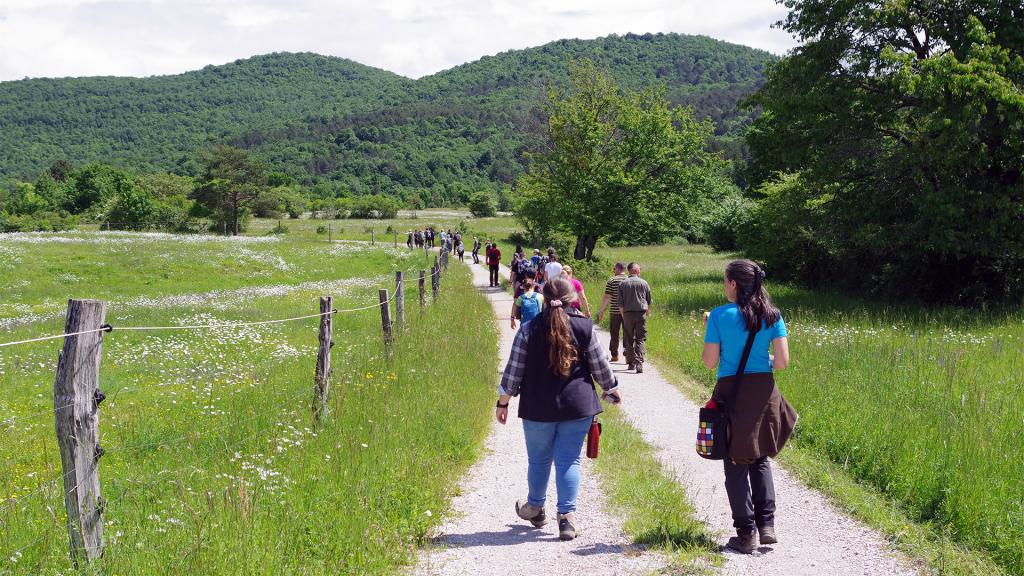
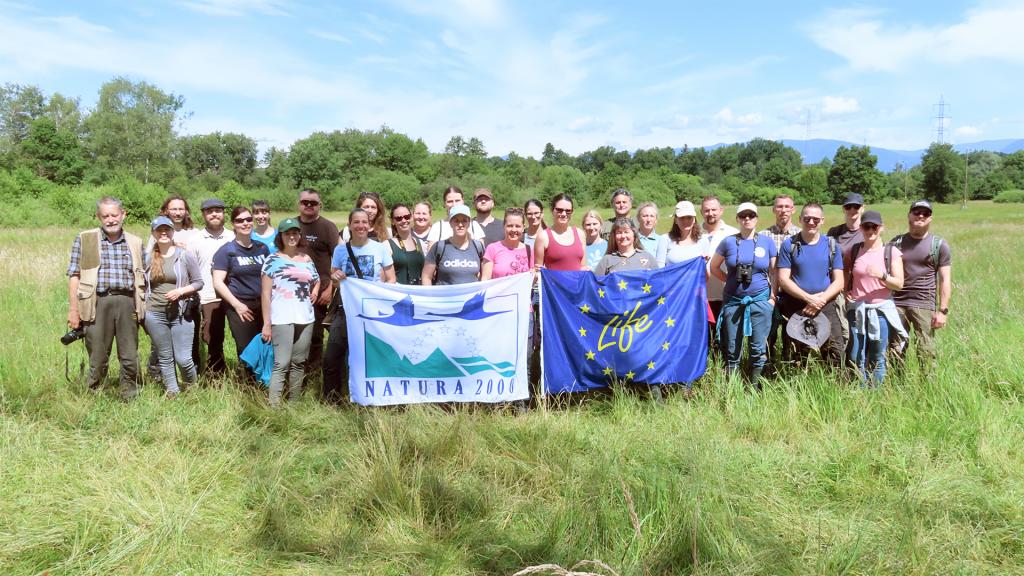
Experts working on the GRASSLAND-HU LIFE Integrated Project participated in a study tour to Slovenia at the invitation of the LIFE-IP NATURA.SI project, which focuses on the management of Natura 2000 sites. During the four-day visit, the Hungarian delegation gained a wealth of valuable professional experience.
The programme began with a visit to Goričko Nature Park, where local people traditionally made their living from agriculture, livestock breeding, and fruit and vine cultivation. In the valleys and on slopes, they cultivated arable fields, meadows, and pastures, while orchards and vineyards were established on the larger and steeper hillsides. Where cultivation was not feasible, shrublands and forests developed, and wetlands formed along the streams. This created a mosaic landscape that provides diverse habitats for many species. Today, the main problem in the region is that livestock farming has ceased leading to natural succession on areas traditionally used as pastures and hay meadows. As a result, these grasslands risk becoming overgrown, threatening the disappearance of valuable species such as the scarce large blue (Phengaris teleius), large copper (Lycaena dispar), marsh fritillary (Euphydryas aurinia), Danube clouded yellow (Colias myrmidone), and the woodlark (Lullula arborea). Another serious issue is the spread of invasive alien species, such as giant goldenrod (Solidago gigantea). Goričko Nature Park is part of the Prekmurje region, known in Hungarian as Muravidék.
During the visit, the Hungarian delegation gained insight into Slovenian approaches to grassland management within Natura 2000 sites, the management of conservation inspections, cooperation with farmers, and the results achieved through these collaborations.
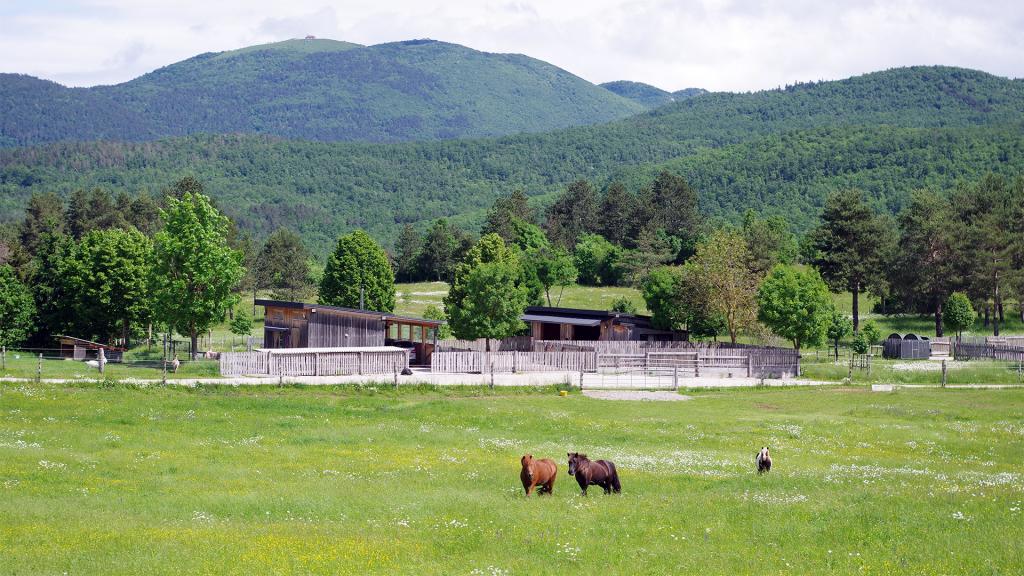
The delegation also visited the Chamber of Agriculture and Forestry of Slovenia, where Hungarian and Slovenian experts exchanged knowledge and experience on the conservation of Natura 2000 grasslands, the results of LIFE projects, the Slovenian agricultural advisory service, and measures under the Common Agricultural Policy (CAP).
Field programme continued in the Draga Valley, located on the southern edge of the Ljubljana Marshes. The valley contains seven artificial lakes, created in the 18th century for fish farming and clay extraction for brick production. Today, the lakes provide habitats for a wide range of aquatic and wetland species. The Hungarian experts also learned about the LIFE URCA PROEMYS project, which aims to improve the conservation status of the European pond turtle (Emys orbicularis) in Italy and Slovenia. The project involves interventions across 55 Natura 2000 sites, including habitat restoration, reintroduction activities, monitoring, and control of invasive species threatening the turtle populations.
Another important stop was the Seasonal Lakes of Pivka Nature Park, renowned for its biodiversity: researchers have recorded 182 plant species, 211 beetle species, 106 butterfly species, and 133 bird species. The park also provides habitat for large carnivores, including the brown bear (Ursus arctos), wolf (Canis lupus), and Eurasian lynx (Lynx lynx). A unique feature of the park is the seasonal appearance of lakes in the karst basin following heavy rainfall, which gives the area its name. The Pivka region hosts 17 seasonal lakes, unique worldwide in both their number and proximity. The park’s experts aim to preserve this extensive cultural landscape through the proper management of wet and dry grasslands, seasonal lakes, and protected forests.
The delegation also visited the Dina Pivka Large Carnivore Center, established under the Interreg project „Cross-border Cooperation and Ecosystem Services for the Long-term Conservation of Large Carnivore Populations”. The center’s interactive exhibition introduces the large carnivores of the Dinaric-Karst region (Slovenia, Croatia), while highlighting the importance of conserving ecosystem services provided by these species. The project team aims to contribute to conflict mitigations, improve coexistence, and enhance the status of large carnivore populations in the cross-border region — which is the main objective of the project. In Drskovče, Juršče, and Klenik, the Hungarian delegation met with local farmers to exchange views on farming practices and coexistence with large carnivores.
Finally, the Hungarian experts traveled to Volčeke, where they learned about the activities and outcomes of the LIFE-IP NATURA.SI project. The project’s main objective is to support the implementation of Slovenia’s Natura 2000 Management Program (2014–2020), and also to improve the conservation status of targeted habitats and species through a long-term, inclusive management approach. Said project aims to improve cooperation and communication among policymakers, landowners, research institutions, and non-governmental organizations. Participants also received information about the operation of the local advisory service and the Slovenian agricultural subsidy system.
Source: Bükk National Park Directorate