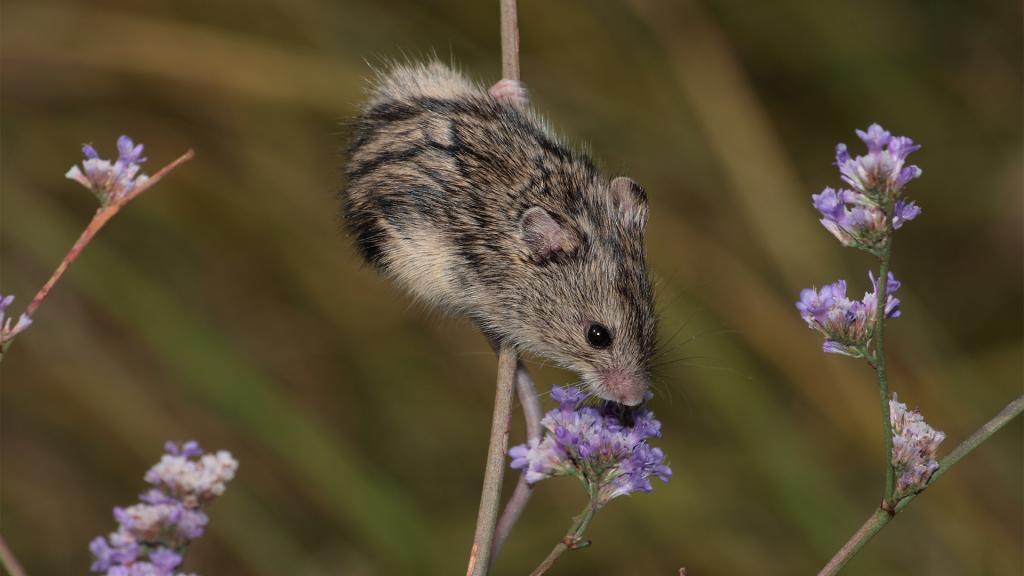
The Bükk National Park Directorate has dedicated a whole autumn research week to the study of the tiny and extremely rare Hungarian birch mouse in the Borsodi-Mezőség Landscape Protection Area. Besides other research groups, the Bükk Mammal Research Group Association and the Hungarian Museum of Natural History were also involved in the fieldwork research.
The programme is supported by the European Union and the Ministry of Agriculture through the GRASSLAND-HU LIFE integrated project. The discussion between Borsod news portal boon.hu and the museum's researcher aimed to explore why the animal is so fond of the Borsodi-Mezőség.
Undisturbed habitat
"Although there are other sites where suitable habitats for the Hungarian birch mouse exist, such as the Hortobágy or the Kiskunság, the population of the mouse species has survived only in the Borsodi-Mezőség. The reason for this phenomenon is not easy to determine." - said Tamás Cserkész, researcher at the Hungarian Museum of Natural History.
According to the expert, this is probably because the birch mice can live relatively undisturbed here. He explained that there have always been remnants of habitat in the Borsodi-Mezőség that are suitable for the species, and in addition heavy rainfall occasionally renders the area inaccessible for weeks or even months.
Consequently, to such conditions patches of habitat that cannot be mowed, which is exactly what the birch mouse prefer. And since the site became designated landscape protection area, the conservation objective is priority so that, for certain areas mowing can be restricted due to the presence of birch mice.
Highly protected
The drought last year decimated the population, though this seems to be a natural process.
"We have been studying the Hungarian birch mouse in the Borsodi-Mezőség since 2006, which is also a habitat for other rodent species. Each year we set live traps at the same time and in the location. As the species is strictly protected, and often referred to as a "national treasure" with a conservation value of HUF 1 million, reflecting its rarity. The population has recently declined somewhat, suspectedly this is not indicative of a major problem but part of a natural process. Rodents’ populations are known to fluctuate dramatically in response to weather conditions. The current decline is most likely linked to last year's drought. Surveys put their numbers in the Borsodi-Mezőség at between 2,000 and 5,000," the museum researcher, Tamás Cserkész said.
Plans for captive breeding
Tamás Cserkész said that the species has several peculiarities. Despite being wild animals they are remarkably tame and show no fear of humans when handled, however they are rarely seen in the wild. Although most photos show the tiny animals perched on stems or inflorescences of plants, this is far from their typical behaviour, as they actually move on the ground and live in burrows they dig in the soil, where photographing them would be difficult.
"Their appearance is distinctive in that the tail length exceeds the body length and a dark stripe runs along the middle of the back bordered with lighter edges. They can easily be confused with the very common striped field mouse, which also have a stripe running down their backs (dorsal), but their base-colour is clearly chestnut brown. In addition, birch mice have a unique diet, despite being classified as rodents, they primarily feed on insects. Furthermore, unlike other rodents, they only produce one litter a year, giving birth to four to five offspring.” - said the expert. Researches are considering breeding them in captivity and reintroducing them to other suitable habitats. “So far, they have only bred successfully once in captivity, at the Budapest Zoo and Botanical Garden, with which we are in continuous collaboration." said Tamás Cserkész.
Source: Greendex