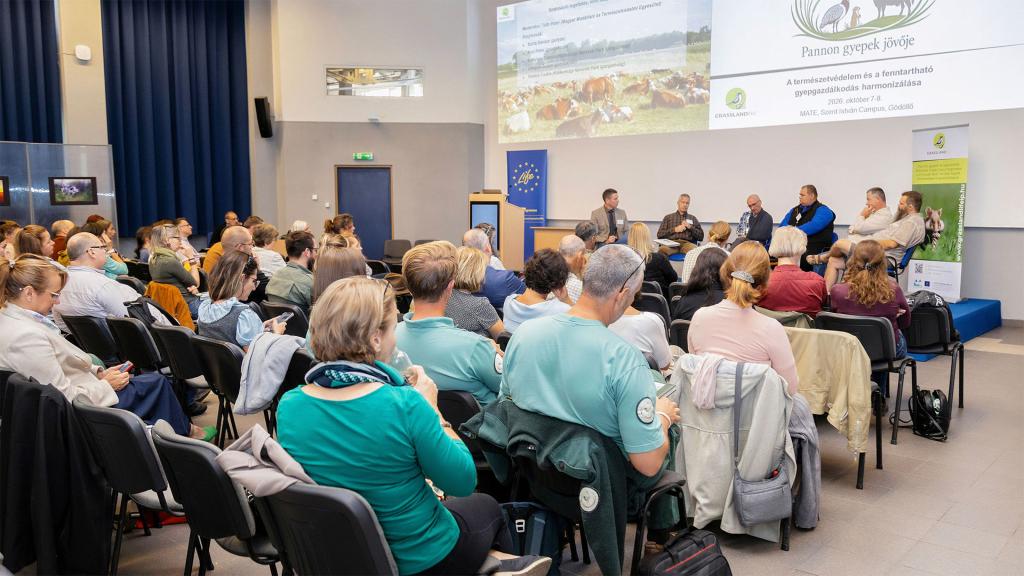
The professional conference entitled “The future of Pannonian grasslands – Harmonising nature conservation and sustainable grassland management”, held in Gödöllő on 7–8 October 2026, attracted considerably more interest than initially anticipated. Organised as part of the GRASSLAND-HU LIFE Integrated Project, the two-day event brought together a total of 250 participants, more than twice the originally planned number.
The remarkable level of interest clearly demonstrates that grassland conservation, sustainable grassland use and the associated challenges are becoming increasingly important issues for professionals representing a wide range of stakeholder groups.
The conference was organised by the Herman Ottó Institute Nonprofit Ltd., in cooperation with the Institute for Wildlife Management and Nature Conservation of the Hungarian University of Agriculture and Life Sciences and the Hungarian Chamber of Agriculture. The aim of the event was to provide a shared professional forum for stakeholders involved in grassland research, conservation management and agricultural use. Particular emphasis was placed on providing opportunities to present not only the latest scientific findings but also practical experience, while enabling representatives of different professional fields to discuss issues concerning the future of grasslands in person.
Shared challenges in a changing environment
Pannonian grasslands are among the most valuable habitats of Hungary’s natural heritage, providing a home for numerous protected and strictly protected plant and animal species. However, their conservation is becoming an increasingly complex task. Climate change, more frequent and severe droughts, changes in water regimes and shifting land-use practices all affect the condition and long-term survival of these grasslands.
It is therefore no coincidence that adaptation to changing environmental conditions was one of the recurring themes of the conference. Several presentations explored how grasslands and the species inhabiting them respond to increasingly dry conditions, as well as the measures available to mitigate adverse impacts.
The research findings and practical examples presented also highlighted that there is no single grassland management solution suitable for every site and every year. The timing, intensity and methods of mowing and grazing must be adapted to the characteristics of individual habitats, conservation objectives and prevailing weather conditions. A management approach that proves effective in one area may not necessarily work elsewhere, and even previously successful practices may need to be reviewed and adjusted from time to time.
From research findings to practical grassland management
The programme of the two-day conference clearly illustrated the complexity of grassland conservation. Presentations covered a wide range of research topics, including grassland biodiversity, the habitat requirements of protected plant and animal species, the ecological impacts of grazing and mowing, and methods for assessing and monitoring grassland condition.
Particular attention was given to opportunities for habitat restoration, the control of invasive plant species, and the potential applications of modern monitoring techniques and geographic information systems (GIS). The findings demonstrated that successful conservation interventions require more than simply selecting and implementing appropriate management methods. Equally important are the long-term monitoring of their impacts, the evaluation of results and, where necessary, the adjustment of management practices.
Alongside nature conservation issues, agricultural and economic considerations also featured prominently. Several presentations addressed sustainable grazing, current challenges in livestock farming, and opportunities to better align conservation objectives with economic interests.
One of the key messages of the conference was that achieving nature conservation objectives and ensuring sustainable grassland management are inseparably linked. Appropriate agricultural use, particularly grazing, plays a crucial role in the long-term preservation of many valuable grassland habitats. However, this requires professional and economic conditions that both meet conservation requirements and remain viable for farmers.
Exceptional interest and professional dialogue
The level of interest in the conference was a pleasant surprise even for the organisers. Originally planned for approximately 120 participants, the event ultimately attracted 250 attendees, clearly demonstrating the strong demand for professional gatherings of this kind.
Participants included researchers, staff members of national park directorates and other nature conservation organisations, farmers, agricultural professionals, university lecturers and students, as well as representatives of relevant institutions and policy sectors.
The presence of participants from diverse professional backgrounds made the event particularly valuable. Over the two days, attendees had the opportunity not only to learn about the latest research findings but also to exchange their own experiences, raise questions and discuss challenges encountered in their everyday work.
These face-to-face meetings and professional discussions are at least as important as the presentations themselves. Nature conservation and grassland management often face the same challenges, although they approach them from different perspectives. Finding shared solutions therefore requires continuous dialogue among researchers, conservation professionals, farmers and decision-makers.
The future of Pannonian grasslands is our shared responsibility
One of the most important lessons of the conference was that conserving Pannonian grasslands will require an increasingly adaptive approach in the decades ahead. In a rapidly changing environment, up-to-date knowledge, regular assessments of habitat condition, consideration of local experience and cooperation across different professional fields are becoming more important than ever.
Experience gained through the GRASSLAND-HU LIFE Integrated Project has also shown that achieving nature conservation objectives requires combining scientific findings with practical experience. The conference provided an excellent opportunity to share this knowledge with a wider professional audience and to contribute to the wider adoption of grassland management practices that are both effective from a conservation perspective and economically sustainable.
We hope that the presentations delivered over the two days, the professional discussions that took place and the new connections established will continue to generate valuable outcomes beyond the event itself, and that the dialogue initiated at the conference will continue in the future.
We would like to thank all speakers, participants, co-organisers and contributors for helping to make the conference such a success!
Source: Herman Ottó Institute Nonprofit Ltd.
Photo: Réti-Michalkó Melinda


